Battle rules
CPU, asynchronous player, and live player battles use the same card-combat rules. Each side brings a legal deck with 3 Creatures and 2 Power cards. The server resolves actions and saves the result; card details and the battle log show the values used in that match.
Why battles use moves
The project brief describes “picking an attribute and comparing it round by round.” Wits World deliberately replaces that mechanic with Creature moves and Power cards.
This gives players decisions throughout a battle: spend limited Power on damage, restore resources, apply a status effect, or swap for a better matchup. A move's value depends on the opponent and the current battle state. Cards therefore offer different tactics, giving deck building a purpose beyond selecting high stats.
The core requirements remain: players choose a deck, take turns against the computer, follow server-enforced rules, and retain completed matches. The team confirmed this departure on 25 August 2026; that confirmation does not record a formal amendment to the supplied brief.
Starting and turn order
Both sides select an opening Creature. Once both choices are resolved, the Creatures are revealed and the server randomly chooses who acts first. Each side has a 50% chance, independent of card stats or who selected first.
Players then alternate normal turns. Each turn allows 1 action: a Creature move, a Power card, or a voluntary swap. Effects resolve before control passes to the opponent. Mandatory replacement pauses this order without spending the replacing player's next normal turn.
Type matchups
Use the move's type against the defending Creature's affinity. A Creature can have Basic moves alongside moves of its own affinity.
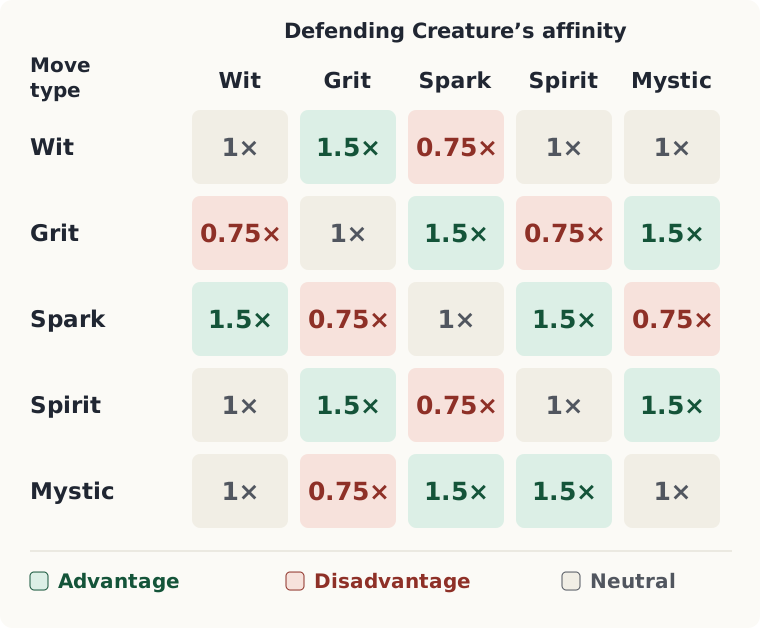
1.5× is an advantage, 0.75× is a disadvantage, and 1× is neutral. Wit beats Grit, Grit beats Spark, and Spark beats Wit. Spirit and Mystic both have advantage against each other. Matching affinities are neutral.
Basic moves and explicitly neutral damage use 1× against every affinity. Type matchups affect damage; healing and Power restoration use their authored amounts.
For example, Quillip's Eureka is a Wit move with 25 base damage. With no other modifiers, it calculates 37 damage against Grit, 18 against Spark, and 25 against Wit. Its Basic Ink Peck calculates 10 against every affinity before other modifiers.
Damage and modifiers
Creature-move damage is calculated as:
floor(base damage × type multiplier × outgoing modifiers × incoming modifiers)
A 20% damage boost contributes 1.2×; a 50% incoming reduction contributes
0.5×. For example, 30 × 1.5 × 1.2 × 0.5 = 27 damage. The server rounds
down after combining the multipliers. Actual HP lost is limited by the target's
remaining HP.
Different compatible damage modifiers multiply together. Reapplying the same authored modifier refreshes its duration or charges. Current Power-card damage and Poison bypass Creature damage boosts and incoming attack reductions.
Power and available actions
Creatures start with full HP and Power. Power is a resource for moves, separate from deck rarity points; a higher Power maximum does not increase a move's base damage.
| Action | Rule |
|---|---|
| Creature move | Pay its Power cost before effects resolve. Enough Power and any HP conditions are required. |
| Power card | Use an available card with an active Creature. It is discarded for the rest of the match. |
| Voluntary swap | Choose a living bench Creature. The swap ends your turn. |
A 0-cost move can remain available at 0 Power. Power is restored by card or move effects; taking turns or resting on the bench does not regenerate it. Healing and restoration stop at the Creature's maximum HP or Power.
Effects execute in their listed order. Overcharge pays 25 HP before restoring Power and requires more than 25 HP. Static Demolition pays 20 HP before its damage and requires more than 20 HP. If an effect ends the battle, later effects do not execute.
Status effects
| Effect | Behaviour |
|---|---|
| Poison | Deals neutral damage at the end of the affected Creature's turns. It can defeat the Creature and remains after its source is defeated. Reapplication refreshes the duration. |
| Stun | Prevents Creature moves. Legal Power-card and swap actions remain available. Recovery grants immunity to another stun. |
| Dodge | Makes the card's chance roll on the next opponent-directed damage effect from a Creature move. The charge is spent whether it succeeds or fails; costs and other effects still resolve. |
| Reflect | Returns a percentage of actual HP damage received, rounded down. Quill Guard's reflection cannot lower the attacker below 1 HP. |
| Lifesteal | Heals a percentage of actual HP damage dealt, rounded down. It starts with subsequent damaging moves, excluding the move that grants it. |
Turn-based durations count the affected Creature's subsequent turns while active. Effects with charges count matching actions instead. Time on the bench does not tick turn-based durations. Poison, Stun, Dodge, Reflect, and Lifesteal refresh their existing effect rather than stacking another instance of that status.
Swapping, defeat, and winning
Swapping preserves each Creature's HP, Power, and remaining effects. The outgoing Creature's end-of-turn effects, including Poison, resolve before the incoming Creature becomes active. The incoming Creature's effects do not tick on that swap turn.
At 0 HP, a Creature is defeated and cannot return during the match. If its side has another living Creature, it must select a replacement before normal play continues. Required replacement does not consume a normal turn.
Defeat all opposing Creatures to win. A confirmed forfeit or resignation records a loss for the departing player. Rewards and rating changes depend on the battle mode; see progression and ranked competition.
Decision deadlines
| Mode | Decision window | Missed deadline |
|---|---|---|
| CPU | 90 seconds for a normal player turn. Opening selection and mandatory replacement have no normal-turn deadline. | A late action becomes a timeout and ends the turn. |
| Asynchronous player | 24 hours for each turn or mandatory replacement. | The required player loses by deadline forfeit. |
| Live player | 60 seconds for opening selection, normal turns, and replacement. | The server selects a legal Creature for a missed selection or replacement, or skips a normal turn. 3 consecutive missed decisions lose the match. |
The server clock decides whether an action is on time; the exact deadline is already late. Refreshing, leaving, or reconnecting does not extend it. In live battles, a timely legal action resets that player's consecutive timeout count.
For controls and navigation, see CPU battles and player battles. Individual move costs and effects are in the card catalogue.
This page was prepared with assistance from Codex[GPT-6].